
Learning to be both
'Why I needed to go wild to find myself,' by V

If I hadn’t deleted Twitter, I’d screenshot the exact moment this guy in his late teens slid into my DMs asking me questions about tech. I’d seen his name everywhere by this point. He was doing VC stuff, podcasts, interviews… The definition of someone hustling!
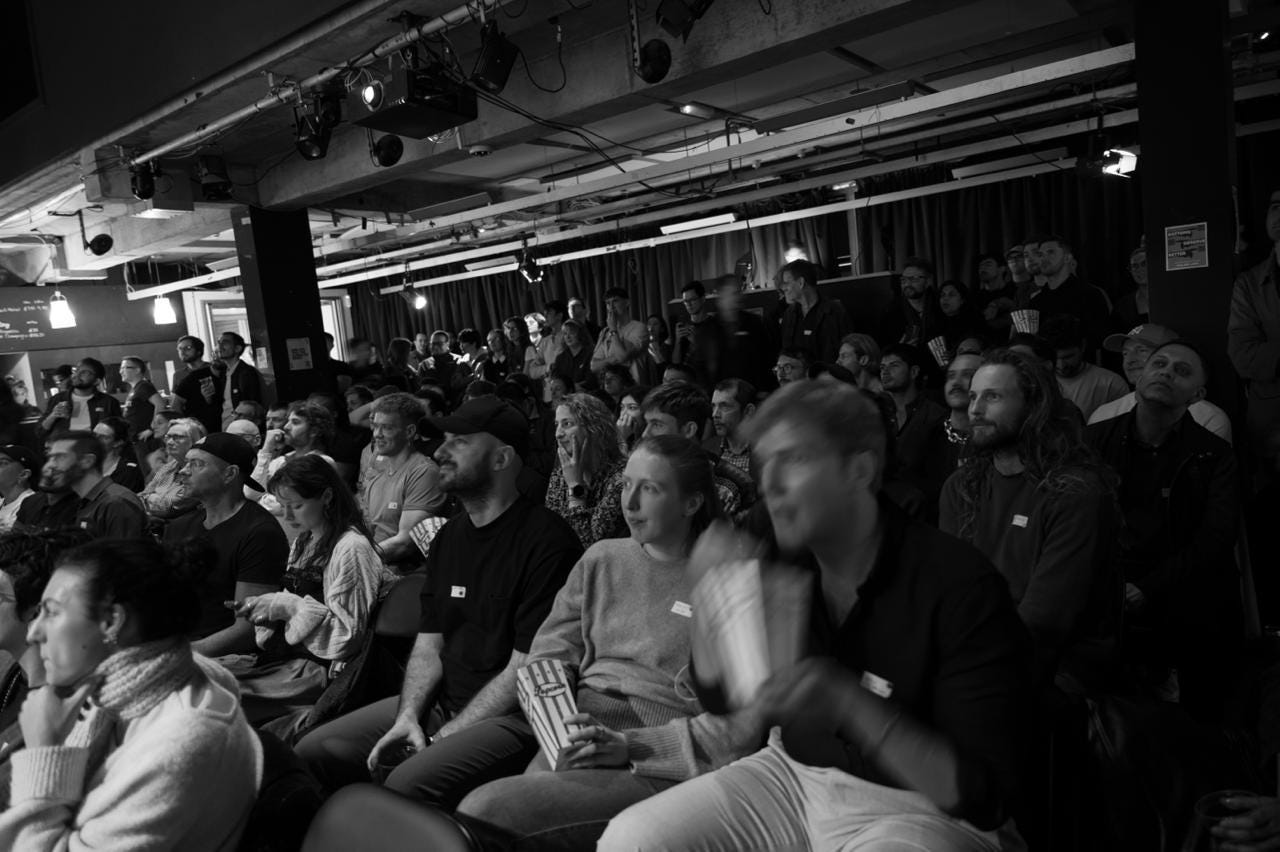
And then he went to university and we sort of lost touch until… Three months ago I was moderating a conversation on the future of sexual health with the lovely team at Polari Labs in a predominantly queer room. I very quickly clocked one of the only other brown faces there. He came up to me and we did the whole ‘Tell me everything I’ve missed in the last six years in 30 seconds’ thing. Then we started chatting about his experiences being brown and being queer given the makeup of the room. And, well, I’ll let him tell you more.
Learning to be both
By V
The smell of the haldi was intoxicating; the stacks of kaju katli, my favourite sweet, sat untouched on the table next to me. I should have been enjoying the festivities — my cousin was getting married in a few days — yet, I was running on about five hours of sleep, after a full on 10-hour shift in a corporate role I was absolutely not qualified for at the age 20. And all I could really think about was the guy’s bed I had spent the previous night in.
This level of chaos wasn’t new to me. I was doing far too much to properly balance a law degree with startup world, a summer job in the city, enjoying my early twenties, plenty of rogue side quests (stories for another day), and coming to terms with who I really was.
A cousin sat down next to me asking about work. Then his mum came over and started the usual, ‘How’s university, beta?’ and then: ‘After X is married, you’re next!’ Which my cousin followed up with the dreaded, ‘Do you have a girlfriend yet?’ My heart started to pump hard, my hands started to sweat, and fight or flight kicked in. My brain tried to muster the energy to deflect the question with the usual excuse: something about being too busy and focused on my career.
I wasn’t surprised by the intrusive questioning around my love life by aunties who felt entitled to know everything. If only they knew! But they couldn’t know. They wouldn’t know. Not until I was ready, not until I was on my own feet. And even then, I will likely spend many more years closeted to many of them. After all, I had spent years hearing the subtle homophobic comments from some of their husbands. So I had become an expert at being seen whilst remaining largely unknown in these rooms.
It has taken a lot of work to even come to surface-level terms with two vastly different, yet oddly similar, parts of my identity. Being gay and being brown.
I came out the day before my GCSE exam, in the midst of a panic attack no less, to two loving, but somewhat conservative, second-gen East-African Indian parents. Not the most cinematic story. What followed wasn’t rejection, but something more difficult to define — silence. On good days, it feels inconsequential. On bad days, the lack of acknowledgement feels impossible to ignore. But silence has a way of teaching lessons words never could.
I probably grew up faster than most around me — my friends would joke that I was a 40-year-old in a 20-year-old’s body. I always did a lot. Partly because the facade of work and studies achievements was far easier to explain than my real life. I needed to be able to impress so I could hide.
Becoming an adult during the pandemic was a blessing in disguise. Whilst many see the internet as harmful, with porn being the initial intro to sex for me and many others of my generation, the copious amounts of time I spent on TikTok and Reddit during lockdown, slowly, very, very slowly, started to help me feel more comfortable in my own skin. This was helped by finally having real friendships in my late teens with people who helped me come out of my shell (I was a pretty lonely child in my early teens). I’m particularly grateful to the women who embraced me without judgment and held my hand when I was unable to stand on my own two feet.
So by the time I moved into the city for university I was ready to start to explore. I went wild, as anyone who knows about my escapades can attest to! Freedom led to a hookup frenzy and the unleashing of an abundance of pent-up closetedness, opening up a part of me which I didn’t know existed or needed to be released. Although I wouldn’t change it, the first few months of university were anything but vanilla or ‘normal’. Within a week of moving out, I had experienced several bouts of racism on Grindr, accidentally hooked up with several men double my age and another guy in a park, was introduced to cruising1, and made out with far too many people I probably shouldn’t have. A couple of months on I had also been exposed (sometimes unknowingly or unwillingly) to everything from open relationships to the world of kink — the latter of which my ‘good brown son’ brain has taken years to fully understand and/or accept. It felt so freeing to not have family eyes on me so I could finally explore a vastly different universe to the one my parents inhabited.
The final few months of university were a whirlwind; my first time coming out to a friend, or hooking up, felt like a lifetime ago. Yet at 21, I still had never been in a proper relationship. I had somehow convinced myself that I wasn’t the type of person people seriously dated — the only gay men I knew in relationships seemed to be attractive white boys. And then I found myself going from fucking around and finding out to being in a serious relationship, deleting very quickly that narrative I had been telling myself. During that relationship, my boyfriend and I went to a party where he introduced me to one of his Muslim friends. This man was in a relationship with another man. I finally saw the lie I’d been telling myself: that brown gay men couldn’t be happy or build serious relationships, and that our queerness existed only in the anonymity of Grindr, Sniffies and Feeld profiles. They could.
Yet, I still struggled with the reality of being both brown and gay, even as I slowly began to accept myself. The emotional contradiction had begun to fade, but the social one had not. Between the homophobia I encountered in some South Asian spaces and the racism that persists in many gay ones, I often felt suspended in between two worlds: visible in both, fully at home in neither. For example, when the firm I was interning at hosted an LGBTQ+ event, I was the only person of colour in the room. In general at Pride events, I became acutely aware of my brownness. At Diwali celebrations, I became acutely aware of my queerness. In time, I somehow mentally just accepted that I could not change that I was brown and gay, and that I would be shunned by people in both spaces. As sad as it sounds, this acceptance led me to actually feel more comfortable with who I was. I couldn’t change everything, nor everyone — what mattered far more was to embrace the people who were there offering their love, support, and guidance.
I had burnt out by graduation and did the only thing you’re meant to do: I spent six months solo backpacking across 11 countries in Asia. It gave me physical space away from expectations, from family, from my career, and from the version of myself I had spent so long trying to maintain. It also gave me mental space to reflect on my queerness outside the context of London, career ambitions, and South Asian family dynamics.
While travelling, I met queer people living vastly different lives to my own. I spoke to an Indonesian man who hid his identity behind an anonymous profile out of fear of death, and an Indian man who feared being rejected by his family if he was ever discovered. Their circumstances were very different from mine, but our conversations reminded me that we were all grappling with the same fundamental question: how much of ourselves could we safely reveal? For the first time, my struggle felt less unique. Not smaller, but part of something much bigger than myself. One thing I’ve learned is that sometimes the people who understand you best are strangers you’ve only just met on the other side of the world.
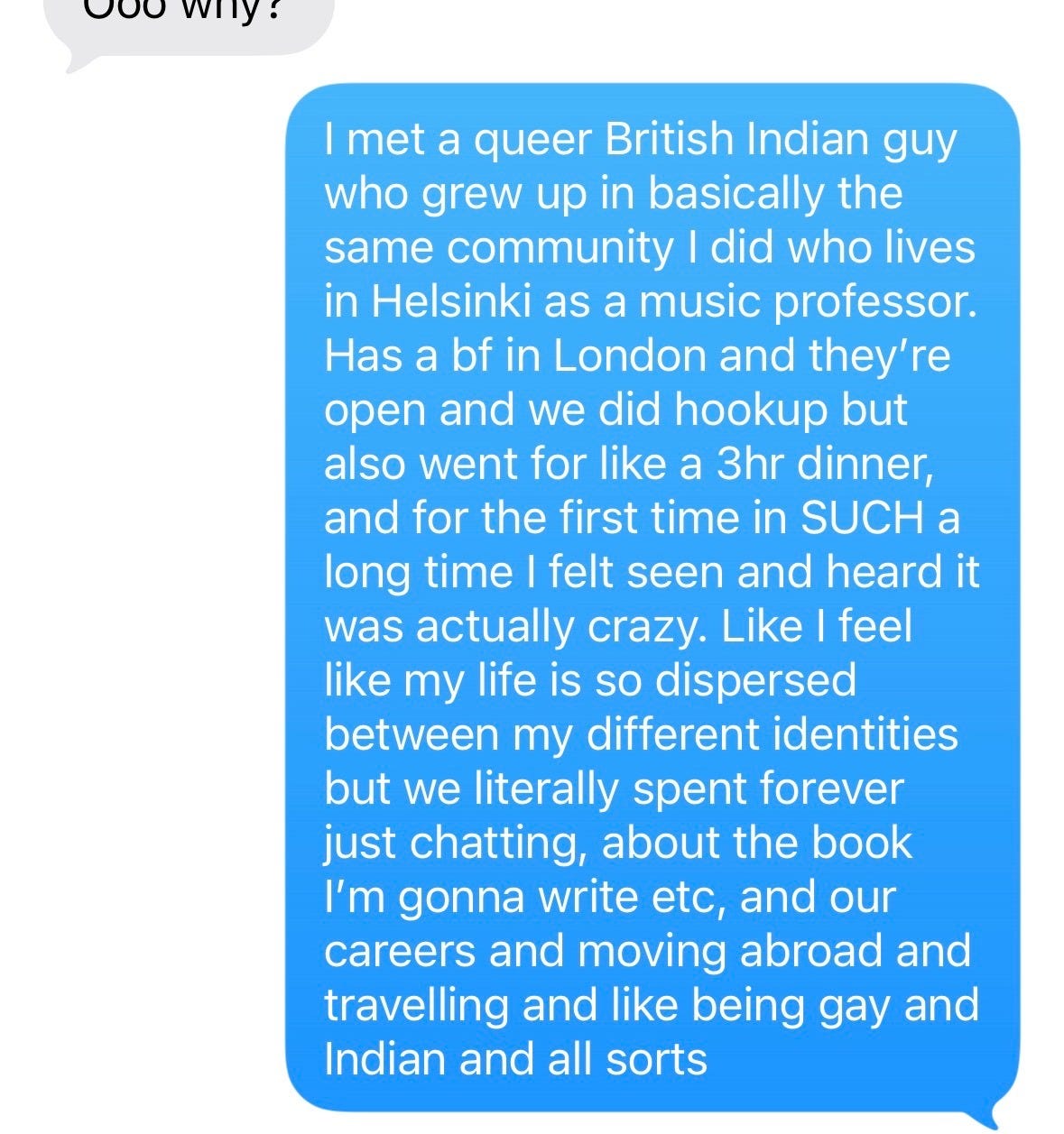
I’ve continued to travel. Last year, while travelling through Finland — possibly one of the whitest places in Europe! — I met a British-Gujarati musician. What started as a casual hookup turned into dinner and hours of conversation. We spoke about family, ambition, relationships, identity, and all the contradictions that come with growing up brown and queer in the West. He was the son of East African Indian immigrants, queer, creative, and building a life entirely on his own terms. For years, I had searched for examples of people who looked like me. Not just queer people. Not just South Asians. For the first time, I felt truly seen by someone who instinctively understood the balancing act I had spent years trying to master. It was comforting to know there are others navigating the choppy waters of queerness and brownness, which I have spent so much of my life trying to reconcile.
Today I am 23 and I’m still exploring. I’m still not fully sure about who I am, but I am able to navigate this tug of war between my queerness and my brownness with knowledge, strength and, crucially, acceptance. The challenge was never being both; it was believing I was allowed to be both. And when auntie asks me when I’m getting married to a girl, I might still deflect and talk about my career. And that’s OK. I’ve realised growth was never about trying to solve myself, it was becoming less afraid of who I’ve always been, for myself… and it’s still none of her business!
Cruising: looking for casual sexual encounters in public spaces, a practice historically engaged in by gay men prior to the decriminalisation of homosexuality, and one which is still a large part of the homosexual experience.
Interesting article